The Hidden Reason Modern Vehicles Keep Killing Their Own Batteries While They Sit
By the Aurisle Team · An owner's account · 7 min read
For three winters straight, I pulled the cover off my rig in spring and turned the key to… nothing. Dead. Not weak — dead. And nothing was even wrong with it. I'd done everything right: I flipped the factory disconnect, I even had a trickle charger on it one year. Then a mechanic I trust told me the thing nobody had bothered to explain — modern vehicles never really shut off, and the two "fixes" I'd been trusting were never going to stop it. Here's exactly what's draining your battery while it sits, and why the usual advice quietly fails.
Fully charged · Day 1Dead · Day 18
12.8Vparked and forgottenflat
The drain you never see: a healthy battery bleeding down, day by day, while the vehicle just sits.
Here's the part that stings if you're the kind of person who takes care of your stuff: the battery didn't die because you did something wrong. It died because your vehicle is built to slowly kill it.
Every modern RV, boat, truck, and even a lot of classic cars now carry a stack of computers that never fully go to sleep. Alarm systems. Keyless entry. Radios that hold presets. Control modules, sensors, clocks. The second you walk away, they keep sipping power — quietly, around the clock.
The numbers are real. Older vehicles used to draw well under 50 milliamps while parked. A lot of newer ones pull 50 to 85 milliamps or more — and some computers keep drawing up to 3 amps for a good 20 minutes after you've already locked up and walked off.
Multiply that tiny, invisible bleed by two or three weeks in storage and you get exactly what owners describe over and over:
"I come back after a couple weeks and the battery's completely dead. Nothing's even wrong with it."
One truck owner put it perfectly on a forum: "the days of leaving a vehicle sit for a couple months and still start are long gone." Another came back to a truck so drained that the key fob wouldn't even unlock it.
That's not you being careless. That's physics and electronics working against you the whole time the vehicle sits.
2
Every Time It Goes Flat, It Dies a Little More — For Good.
Most people think a dead battery is a one-time annoyance. Jump it, charge it, move on. It's worse than that — and more expensive than that.
Every time a battery gets drained down deep, it takes permanent damage. It's called sulfation, and here's the part nobody tells you: the battery never fully recovers. It loses a little capacity every single time. That's why so many owners find themselves saying:
"I'm on my second battery in a year. Something's draining it and I'm done buying batteries."
So the real cost was never the jump-start. It's the slow, repeated killing of a battery you paid good money for — $150 to $400 for an RV or marine battery, and thousands for a lithium setup — dying years before it should.
And that's before you count the day it actually strands you: the tow, the emergency battery bought at whatever price the one open shop is charging, the launch you missed, the trip that started with you hunched over the engine instead of pulling out of the driveway. As one boater said, "being dead in the water is a scary thing — you can't get away from anything."
It's not a $100 problem. It's a $400 problem that keeps coming back.
3
Your Factory Disconnect Isn't Actually Disconnecting.
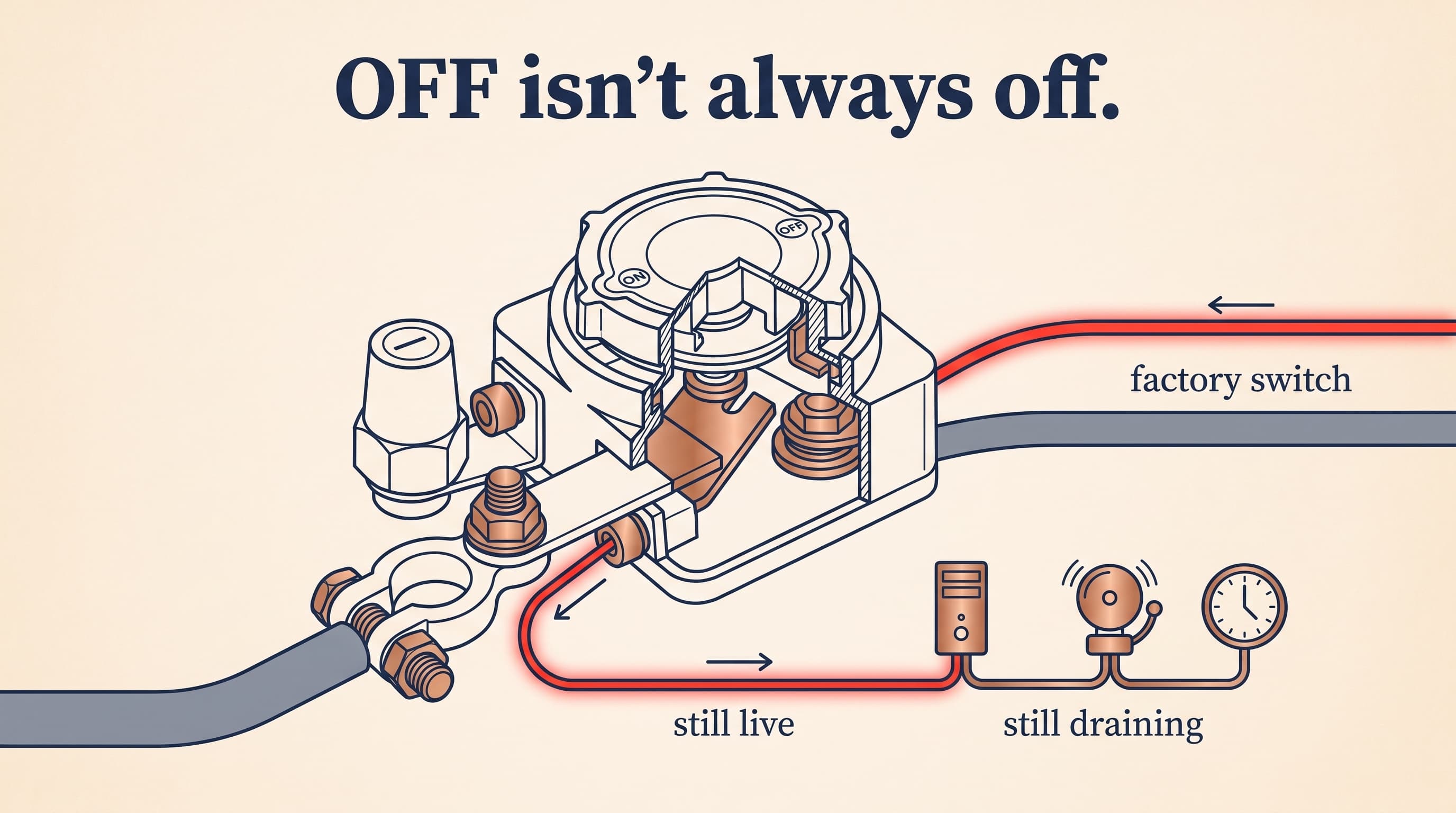
"But I flip my battery switch." So did I. Here's the ugly little secret that took me years to learn: on a lot of vehicles, the factory disconnect doesn't truly cut the battery off.
Depending on how it's wired, that switch often leaves a live path running straight to the very electronics that are draining you — the alarm, the memory, the monitors. You think everything's off. It isn't. Which is why owners keep discovering:
"So much for the factory disconnect — two weeks and the batteries are dead anyway."
A switch that leaves the drain running isn't protection. It's a light switch on the wrong wire. And unless you know exactly how yours is wired, you have no way of knowing whether it's doing anything at all.
4
And Your Trickle Charger? It's Treating the Symptom.
The other piece of advice you'll hear everywhere is "just put a trickle charger on it." I did. And a battery tender absolutely has its place — but understand what it actually is: a bucket under a leak.
A trickle charger doesn't stop the drain. It just tries to pour power back in as fast as the electronics pull it out. Which means:
It needs a wall outlet — useless in a slip, a field, a storage lot, or anywhere your rig or boat actually sits.
It can't revive a battery that's already gone down too far — once it's deep-discharged, the damage is done.
A cheap or aging one can overcharge and cook the battery — trading one way to kill it for another.
You're not solving the problem. You're paying for electricity to fight a leak you could have just shut off — if only your disconnect actually disconnected.
So here's where that leaves you. The drain is real, it's permanent, and it's costing you over and over. The switch you trusted doesn't truly break the circuit. The charger everyone recommends only treats the symptom — and needs an outlet you don't have.
Which raises the obvious question — the one that sent me looking for something better:
If the switch won't disconnect it and the charger won't stop it… what actually does?
That's exactly what I found — and it's not what I expected.
5
There's Only One Way to Truly Stop the Drain: Take the Battery Out of the Circuit — Without Draining It to Do So
Once I understood the problem, the answer got simple. You can't out-charge a leak, and you can't trust a switch that leaves a live wire running. The only thing that actually stops parasitic drain is truly breaking the circuit — cutting the battery off from the electronics completely, so there's nothing left to bleed it.
But here's the catch that trips up most people, and it's the reason the cheap remote switches on the internet don't fix anything either:
Most powered disconnects drain the very battery they're supposed to protect.
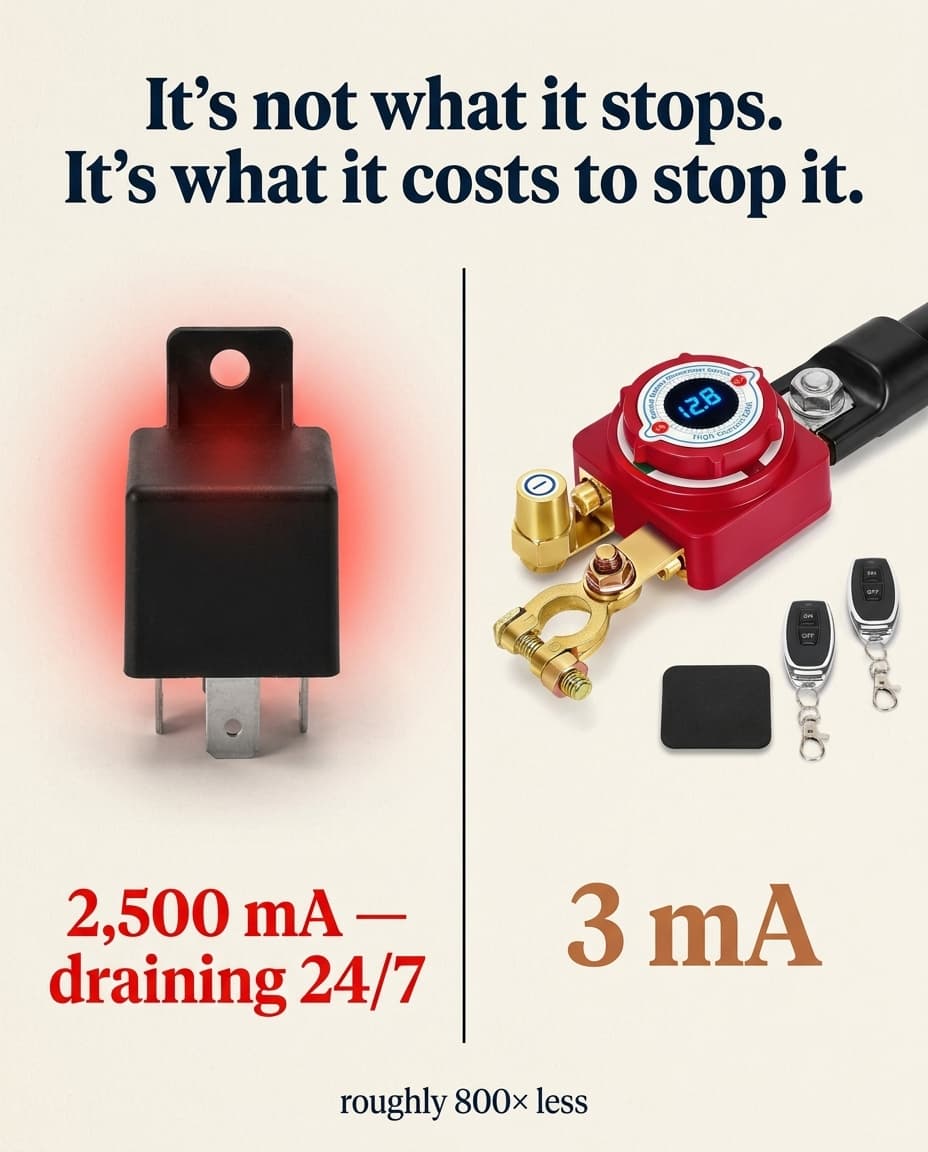
The common remote units use a solenoid that has to keep drawing current the entire time just to hold itself engaged. One popular one pulls around 2.5 amps around the clock. Think about that — you install a device to stop a drain measured in milliamps, and it replaces it with a drain measured in amps. Owners figure it out fast:
"So if the thing itself drains the battery… what's the point?"
That's the whole game right there. The fix has to break the circuit completely — and then hold that state on next to no power at all. Cut the battery off, and give almost nothing back to hold it there.
Break the circuit completely. Then hold it there on next to nothing.
The factory switch won't fully break it. The charger won't stop it. The cheap remotes create a bigger drain than the one they solve. That gap is exactly what Aurisle built for.
6
Meet Aurisle SmartGuard — The Disconnect That Actually Disconnects (And Takes Nothing to Do It)
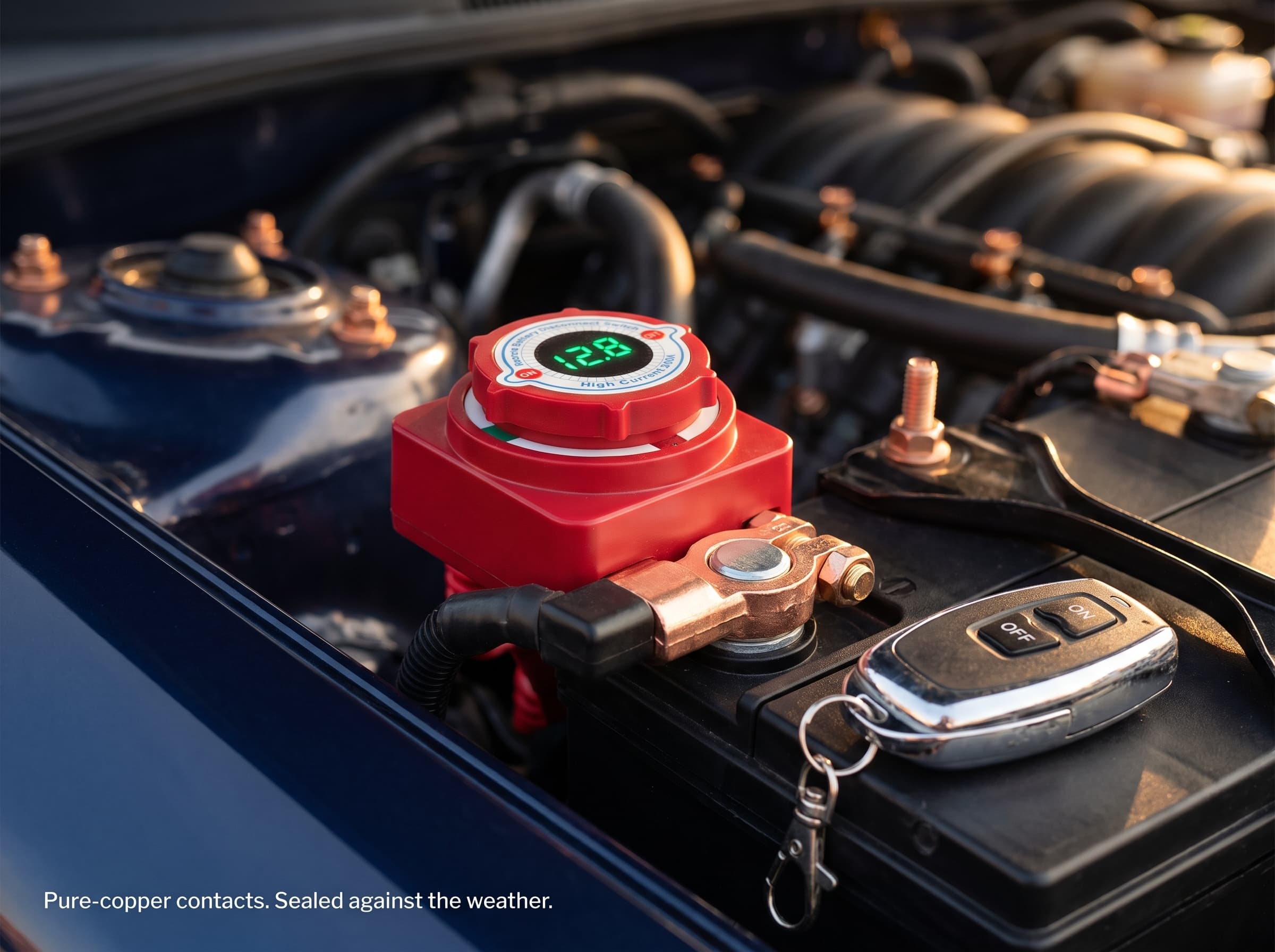
Pure-copper contacts. Sealed against the weather.
Aurisle SmartGuard clamps onto your battery's negative terminal and does the one thing every other "fix" fails to do: it fully breaks the circuit — and it uses a magnetic-latching design that holds that disconnect on just 3 milliamps.
Read that number again, because it's the whole point. Those cheap remote switches burn around 2,500 milliamps just to stay engaged. SmartGuard holds the exact same job on 3 — roughly eight hundred times less. It's the difference between a device that quietly drains your battery and one that, for all practical purposes, takes the battery out of the drain entirely.
Cut the power, and the electronics get nothing. No slow bleed. No live wire you didn't know about. No remote unit sitting there eating amps in the background. The drain doesn't get charged around or babysat — it gets shut off at the source.
And because it's smart, you're never guessing again:
Flip it on or off by remote — from the driver's seat, the dock, the garage, the kitchen window. No popping the hood. No crawling into the bilge. No hunting for a wrench in the dark. And two remotes come in the box, so there's always a spare.
See your battery's voltage at a glance — a real-time readout tells you your battery's condition before you turn the key, so a weak battery never ambushes you again.
Automatic low-voltage protection — if the battery ever sags to around 11.8V, SmartGuard waits a couple of minutes to be sure, then cuts power on its own to help stop the deep discharge that permanently kills batteries.
A manual button right on the unit — so if you ever misplace a remote or a remote battery dies, you're never locked out of your own vehicle. You always have a way to turn it back on by hand.
It won't let you cut power while you're driving — once the engine's running and charging, the remote locks out, so there's no way to accidentally kill power at the wrong moment. It knows the difference between parked and running.
Now — I know what you're thinking, because I thought it too: is this just another cheap import that dies in a season? Fair question, and it's the right one to ask. So here's the straight answer:
It's built with pure-copper terminal connections for a solid, low-resistance hold — not pot-metal that corrodes.
It works on both 12V and 24V systems and is rated to 240 amps continuous — so it handles everything from a classic car to a big dual-battery diesel or a boat's house bank.
It's sealed against the weather — built to take heat, cold, vibration, and the wet, on the road or on the water.
And it's backed by a 60-day money-back guarantee — try it on your own vehicle, and if it doesn't do exactly what I've told you, send it back.
This isn't a $30 knob from a bin. It's a protection system for something you actually care about.
7
It Goes On in Minutes — No Wiring, No Cutting, Nothing to Undo
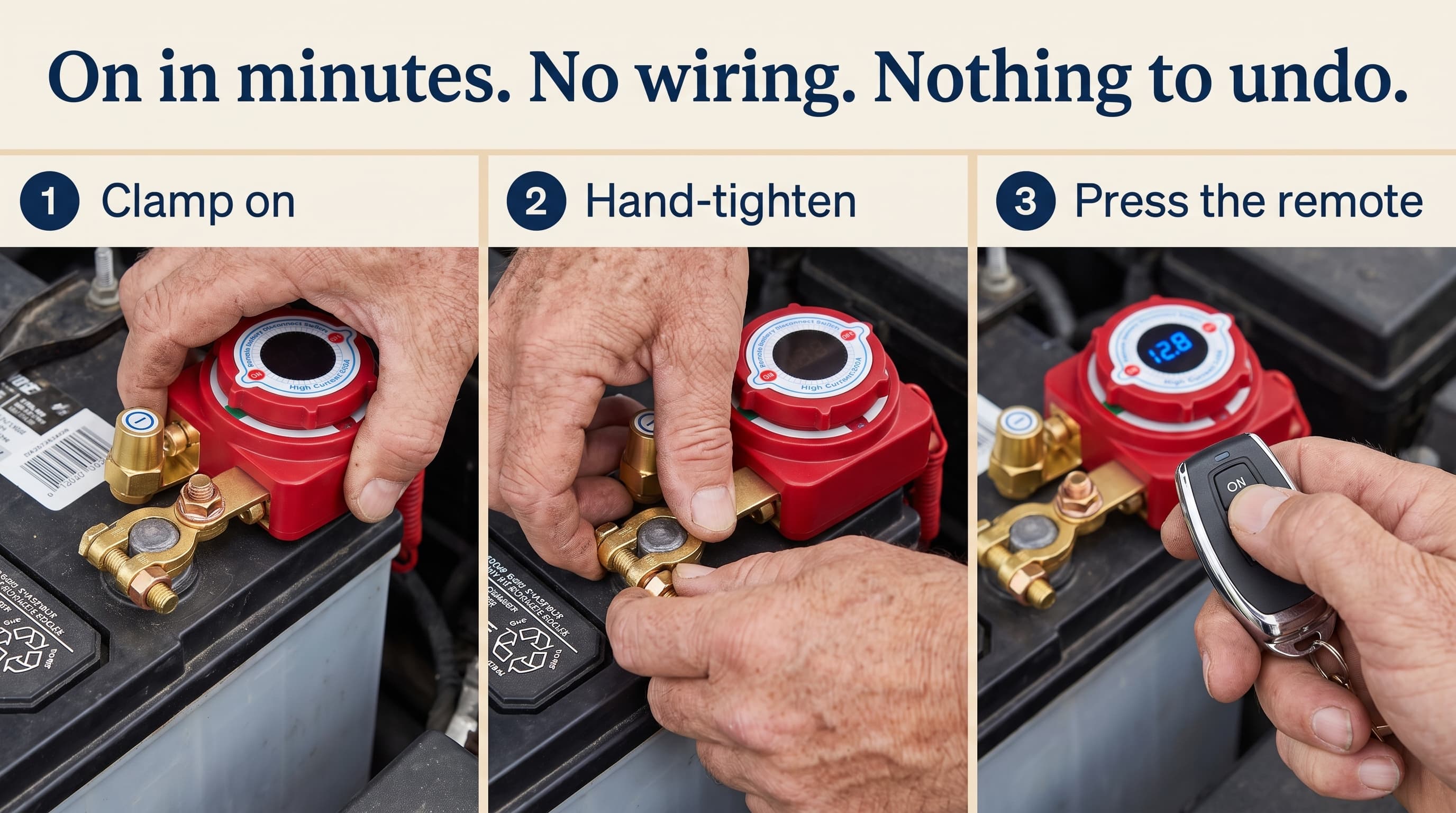
One more thing that mattered to me, because I didn't want to butcher my rig to protect it: SmartGuard installs without modifying a single factory wire.
It clamps right onto the negative battery terminal. No cutting, no splicing, no dropping the dash to fish wires. Most people have it on in just a few minutes with no special tools. And because nothing is permanent, it's fully reversible — take it off anytime and your vehicle is exactly as it was, warranty and all.
One honest heads-up: because SmartGuard truly cuts power, things like your radio presets and clock will reset when it's off — the same as unhooking the battery by hand. That's not a flaw. That's how you know it's actually working, instead of leaving a live wire behind like the factory switch does.
If you can tighten a wing nut, you can install it. Then the only thing you do from then on is press a button.
The Math That Made It a No-Brainer
I'm a "run the numbers first" kind of person, so I did. Here's how the cost of actually solving this stacks up against the cost of living with it:
A new RV or marine battery (again)
$150–$400+
A single roadside jump or tow
$75–$150
An emergency battery bought while stranded
way more than planned
A ruined trip, launch, or show day
priceless — and unforgettable
Aurisle SmartGuard — protects the battery on every vehicle, every season
$99
When one dead battery costs more than the device that prevents all of them — and keeps them from dying early on top of it — the switch stops being an expense. It's the cheapest insurance you'll ever buy for something you've spent thousands on.
Hear From Other Owners
The pattern owners describe again and again is simple: park it, forget about it, come back, and it starts. As one put it — "I just want it to fire right up the day I'm ready to go." That's the whole point. That's all any of us wanted.
Protect It Before the Next Time It Sits
Here's the honest truth about timing: your battery isn't going to warn you. It drains quietly while the vehicle sits, and you find out the day you're already loaded up and ready to roll. The move is to handle it before you park it next — not after the next dead battery.
If you've got a rig, a boat, a truck, or a classic that sits between uses, this is the thing that finally lets you walk away from it and not think about it again.
Stop charging around the drain. Stop trusting a switch that doesn't disconnect. Shut the drain off at the source — on next to no power at all.
60-Day Money-Back Guarantee. Put SmartGuard on the vehicle you care about. If it doesn't stop the drain and give you back your peace of mind, contact us within 60 days for a full refund. No forms, no hassle.